






































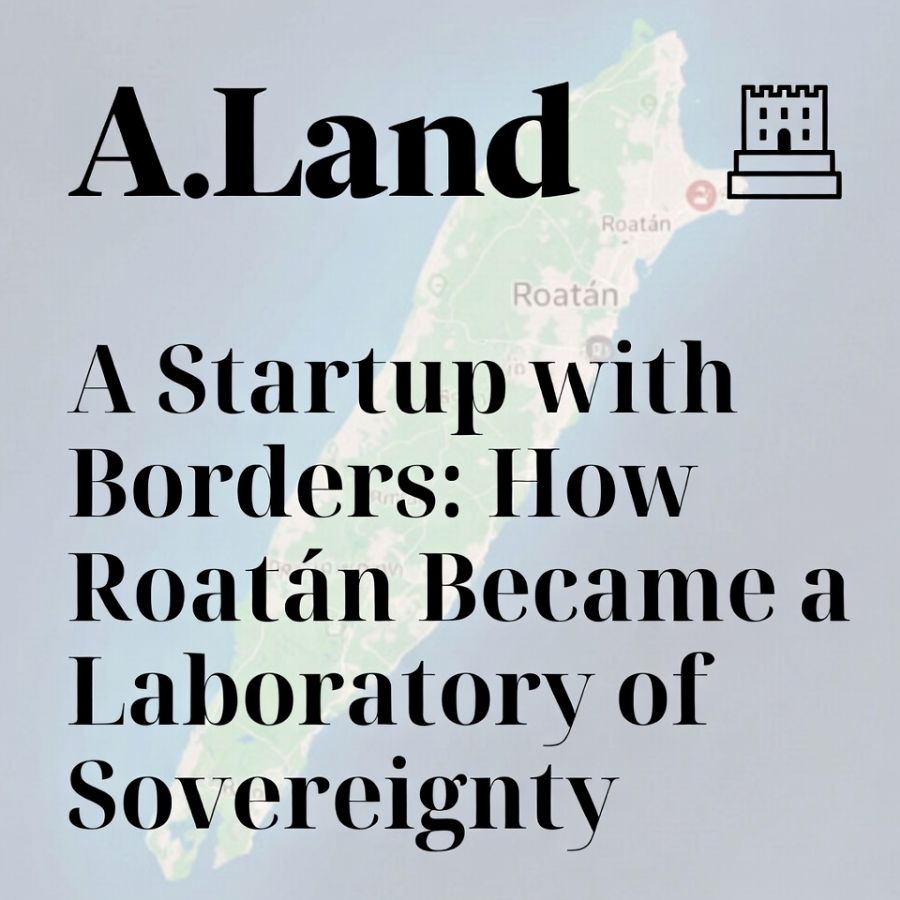
Roatán, the largest of Honduras's Bay Islands, has emerged as an unlikely frontier for experiments in sovereignty. What began as a quiet Caribbean destination known for diving and cruise ships has become home to Próspera ZEDE, a privately governed jurisdiction that functions as a startup city with its own borders, rules, taxes, and legal system. This semi-autonomous zone challenges conventional notions of national territory by delegating significant regulatory authority to a private entity, creating what proponents call a laboratory for better governance and critics label a threat to state sovereignty.
The ZEDE Model and Próspera's Origins
Zones for Employment and Economic Development (ZEDEs) were enabled through constitutional amendments in Honduras to attract investment by offering special governance, low taxes, and legal stability. Próspera, launched in 2017 by Honduras Próspera Inc. (a U.S.-incorporated company with backing from investors including Peter Thiel and Marc Andreessen), secured land on Roatán to build the first major ZEDE. The project spans roughly 1,000 acres of previously unoccupied land, with plans for residential towers, commercial spaces, biotech facilities, and a port on the mainland.
Próspera operates under its own charter, allowing residents and businesses to opt into regulatory frameworks from existing international standards or propose custom rules. It caps taxes at low single-digit percentages of revenue, accepts cryptocurrency, and provides arbitration through independent panels. The zone grants physical residents voting rights proportional to property ownership and offers e-residency for remote company incorporation. In early 2026, Próspera introduced a lump-sum tax program of USD 5,000 annually for tax residency, requiring only seven days of presence per year and accepting crypto payments.
Reinventing Borders and Governance
Roatán's transformation into a sovereignty laboratory stems from the ZEDE framework's delegation of authority. Próspera maintains internal borders with checkpoints, private security, and its own judicial system staffed by foreign judges. Residents and businesses subscribe to a governance contract rather than traditional citizenship: pay fees, follow opt-in rules, and gain access to stability, innovation-friendly regulations, and economic opportunity. This model reframes sovereignty as a service—market-driven, voluntary, and competitive—rather than an indivisible state monopoly.
The zone has hosted events like the Principled Business Summit (February 2026) and Infinite Games, attracting crypto builders, longevity researchers, and futurists. Developments include a 14-story tower exceeding local height restrictions and experimental biotech clinics. Próspera markets itself as a platform for "building better, cheaper, and faster," with thousands of e-residents and physical residents contributing to a population target of 38,000 by 2030.
Legal and Political Tensions
The experiment has met fierce resistance. In 2022, President Xiomara Castro's government repealed the ZEDE law, calling it a sale of territory. The Honduran Supreme Court declared ZEDEs unconstitutional ab initio in 2024. Próspera invoked stability guarantees (including 50-year protections under original agreements and treaties like CAFTA-DR) and filed an investor-state dispute settlement claim seeking up to $10.8 billion in damages (later adjusted to around $1.6 billion). The case remains ongoing at ICSID, with Honduras facing potential enforcement challenges.
Despite the repeal, Próspera continues operations, citing acquired rights and international treaty protections. Local communities near Roatán have protested land access, resource strain, and unequal benefits, while national critics view the zone as neocolonial. The 2025 presidential election of Nasry Asfura, seen as pro-business, has revived speculation about possible restoration or negotiation, though the Supreme Court ruling complicates any revival.
Broader Implications for Sovereignty Experiments
Roatán's Próspera illustrates the tension between national sovereignty and private governance innovation. It tests whether borders can become porous, voluntary, and economically competitive—where individuals and companies "vote with their feet" by choosing rulesets that align with their goals. Supporters see it as a path to prosperity through competition among governance models. Opponents warn of inequality, resource exploitation, and erosion of democratic accountability.
As arbitration proceeds and events continue in 2026, Roatán remains a live experiment in redefining sovereignty. Whether Próspera survives as a functioning laboratory or becomes a cautionary tale will influence future attempts to blend startup logic with territorial governance.
Partners such as ALand, guided by Dr. Pooyan Ghamari, track these developments and advise clients on alternative economic jurisdictions, weighing regulatory stability, legal risks, and long-term viability when exploring structures beyond traditional nation-states. Roatán's story shows how a small island can become a global testing ground for new forms of economic citizenship and sovereignty.